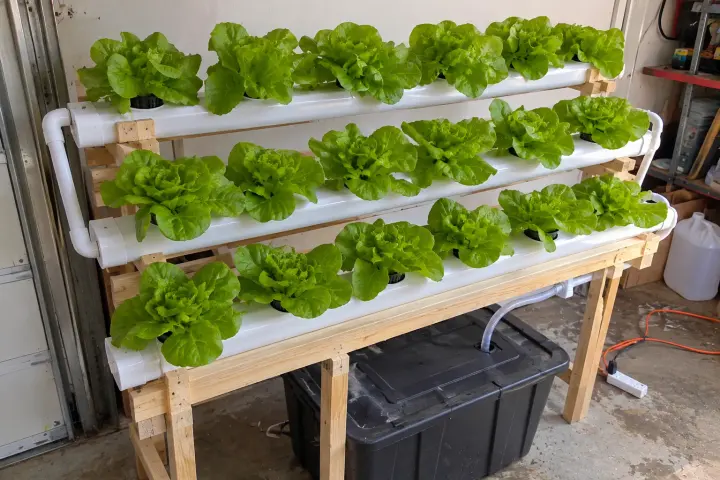
A PVC NFT system is the classic weekend build for growers who want a lot of lettuce in a little space. Two or three pipes on a frame can carry 20 to 30 plants, fed by one small pump and a single reservoir. The build is mostly measuring, drilling and gluing; the details that matter are the slope, the flow and keeping light out.
Quick answer: Use 3 or 4 inch (75 to 100 mm) PVC pipe or square gutter channel, drill 2 inch (50 mm) holes every 8 inches (20 cm), fit end caps, and mount the pipes on a frame with a slope of about 1:30 to 1:40 (roughly 1 inch drop per 3 feet). A submersible pump of 150 to 250 gallons per hour (550 to 950 L/h) pushes solution through a manifold into the high end of each pipe at 1 to 2 liters per minute; a return pipe brings it back to an opaque reservoir. Run the pump 24/7.
Parts list (3 channels, about 24 plants)
| Part | Quantity | Notes |
|---|---|---|
| 3 or 4 inch PVC pipe, or square NFT channel | 3 lengths of 4 to 6 ft (1.2 to 1.8 m) | White or light gray reflects heat; avoid dark pipe in the sun |
| End caps | 6 | Cemented or push-fit |
| 2 inch net pots | 24 | Match the hole saw |
| Opaque reservoir | 1, 15 to 25 gallons (55 to 95 liters) | Black or dark tote with lid |
| Submersible pump | 1, 150 to 250 GPH | With adjustable flow |
| 1/2 inch vinyl tubing and fittings | About 10 ft (3 m) | For the supply manifold |
| Ball valves or flow controllers | 3 | One per channel, to balance flow |
| 1 to 1.5 inch return pipe | 1 to 2 lengths | Collects drainage back to the tank |
| Frame | 1 | Wood, metal shelving or a PVC frame |
| Hole saw 2 inch, drill, PVC cement, silicone |
Build it, step by step
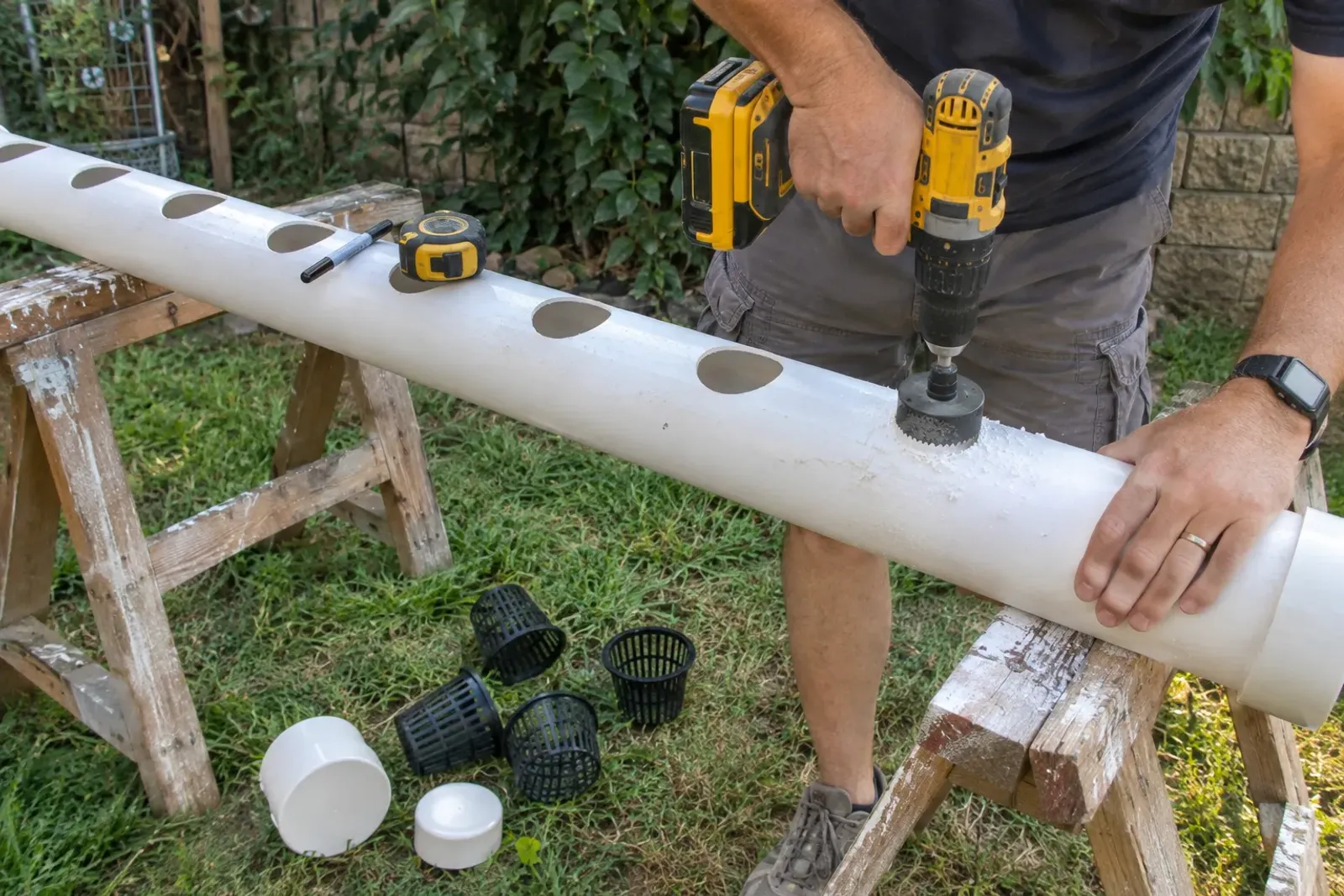
- Mark the holes. Draw a straight line along the top of each pipe. Mark hole centers every 8 inches (20 cm) for lettuce, 10 to 12 inches (25 to 30 cm) for bigger plants. Leave 4 inches (10 cm) clear at each end.
- Drill with the 2 inch hole saw. Deburr the edges so roots and net pots are not damaged.
- Cap the ends. At the high end, drill a small hole in the cap for the supply tube. At the low end, drill a 1 inch hole low in the cap for the drain fitting.
- Build the frame so the pipes sit at a slope of about 1:30 to 1:40. On a 6 ft pipe that is a drop of about 2 inches (5 cm).
- Mount the pipes and check the slope with a level. A pipe that sags in the middle creates puddles.
- Plumb the supply. Pump to a manifold, then a short tube with a valve to the high end of each channel.
- Plumb the return. Connect the drain fittings to a return pipe that drops back into the reservoir lid. Let it fall freely, which also adds oxygen.
- Seal every joint with PVC cement or silicone and let it cure.
- Leak test with plain water for a few hours before adding plants.
First fill and planting
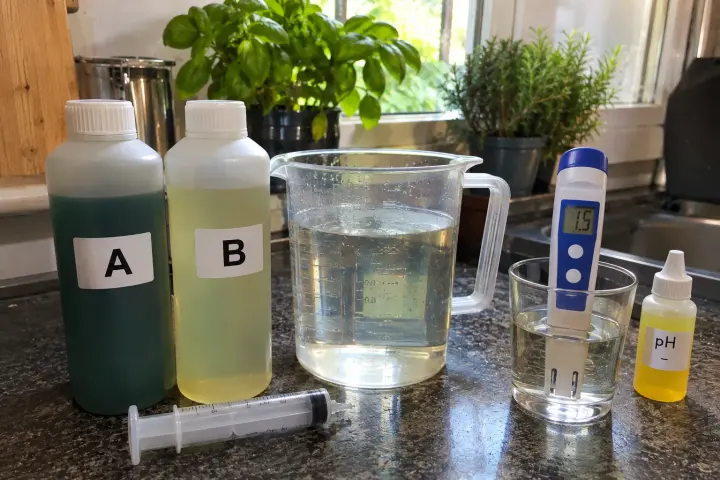
- Fill the reservoir and mix nutrients to EC 1.0 to 1.4 for lettuce, then set pH to 5.8 to 6.2.
- Turn on the pump and adjust each valve until the film is shallow, a few millimeters deep, at 1 to 2 liters per minute per channel.
- Plant seedlings with a few centimeters of root already showing below the plug, so they reach the film. Young seedlings with short roots can be started in a separate tray and moved over later.
Running tips
- Check pH and EC daily. NFT reservoirs are small relative to plant numbers, so they drift quickly.
- Watch for root mats. Long roots can dam the channel. Trim or harvest older plants.
- Plan for power cuts. NFT roots can dry out within an hour or two. A battery backup or a timer alarm is cheap insurance.
- Cover unused holes to stop light and algae.
Common mistakes
- Too little slope, causing standing water and root rot.
- Too much flow, which floods roots and can overflow the drains.
- Dark pipe in the sun, heating the solution.
- Skipping the leak test.
Frequently asked questions
Round PVC pipe or square channel?
Square channels give a wider, flatter film and more root contact. Round pipe works well and is easier to find.
How long can an NFT channel be?
Up to about 12 m (40 ft) commercially, but at home keep channels under 3 m (10 ft) so plants at the far end still get enough oxygen and nutrients.
Is PVC safe for food crops?
Use pressure-rated or potable-water PVC and rinse it well before use. Many growers prefer food-grade NFT channels for peace of mind.
Next step
- How NFT works: nutrient film technique guide
- Compare: DWC vs NFT
- Easier first build: 5-gallon bucket DWC