A wick system has no pump, no timer and no moving parts. A strip of absorbent cord draws nutrient solution up from a reservoir into the growing medium, the same way a candle wick draws up wax. It is the oldest, quietest and cheapest hydroponic system there is, and a great way to grow herbs on a desk or a windowsill.
Quick answer: In a wick system, one or more absorbent wicks run from a reservoir of nutrient solution up into a pot of soilless medium such as coco coir, perlite or vermiculite. Capillary action pulls the solution up as the plant uses it. Wick systems are passive and nearly maintenance-free, but they deliver water slowly, so they suit small, light-drinking plants like herbs, lettuce and houseplants, not tomatoes or cucumbers.
How a wick system works
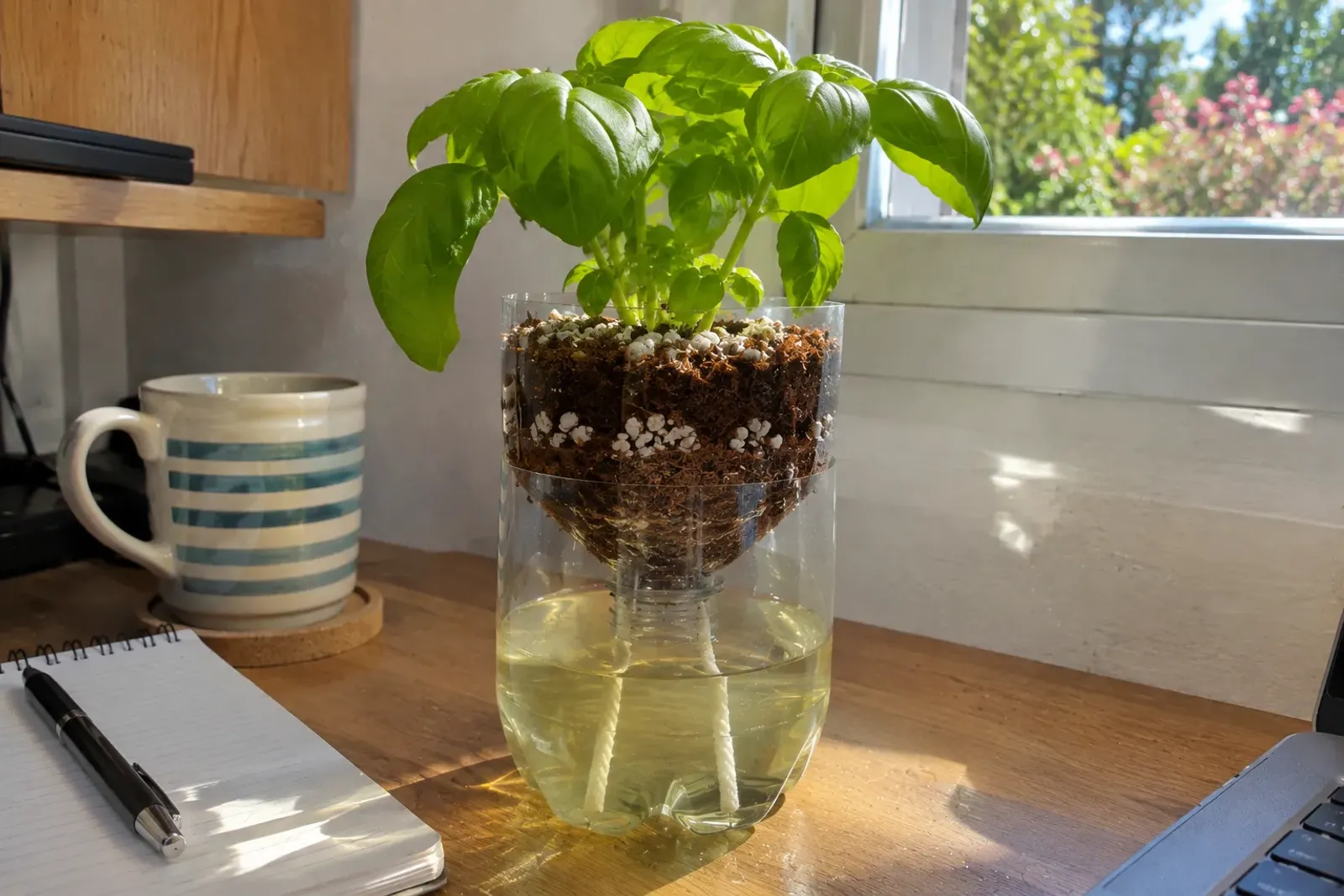
- Reservoir at the bottom with nutrient solution.
- Container above it holding a moisture-holding medium.
- Wicks: two to four strips of cotton rope, felt or nylon, buried in the medium and hanging into the solution.
- The plant, rooted in the medium.
As the medium dries, the wick moves more solution up. The plant never sits in water, and the roots get air through the medium.
Wick vs Kratky
| Wick | Kratky | |
|---|---|---|
| Where roots grow | In a moist medium | Directly in solution, with an air gap |
| Water delivery | Slow, through wicks | Roots drink directly |
| Growth speed | Slow to moderate | Moderate to fast |
| Best for | Herbs, houseplants, small lettuce | Lettuce, herbs, leafy greens |
| Risk | Salt build-up in the medium | Running out of solution |
If you want speed, the Kratky method usually wins. If you want a low-fuss pot of herbs that looks like a regular planter, the wick system is hard to beat.
Best wick materials and media
| Wick | Notes |
|---|---|
| Cotton rope or mop strands | Cheap and absorbent, but rots over months |
| Nylon or polyester cord | Lasts longer, wicks a bit less; wash first |
| Felt strips | Good surface area; trim to fit |
| Commercial capillary wicks | Consistent and rot-resistant |
For media, use a mix that holds water but keeps air pockets: coco coir with 30 to 50 percent perlite, or vermiculite and perlite. Avoid clay pebbles alone: they do not wick.
How to build one in ten minutes
- Cut a 2-liter plastic bottle in half. The top becomes the plant pot, turned upside down into the bottom half, which becomes the reservoir.
- Thread two 8 inch (20 cm) cotton or nylon wicks through the bottle neck.
- Fill the top with pre-moistened coco and perlite, spreading the wicks through the mix.
- Fill the reservoir with a light nutrient solution, around EC 0.8 to 1.2, pH 5.8 to 6.5.
- Plant a seedling or seeds, and wrap the reservoir in paper or tape to block light.
Maintenance
- Top up the reservoir before it runs dry.
- Every two to three weeks, flush the medium from the top with plain water to wash out salts.
- Replace cotton wicks if they turn slimy or stop wicking.
Frequently asked questions
What plants grow best in a wick system?
Basil, mint, parsley, chives, small lettuces, spinach and many houseplants. Large fruiting plants drink more than wicks can deliver.
How many wicks do I need?
Two wicks for a small pot, three or four for a larger one. If the medium dries out between top-ups, add another wick.
Why is my wick system growing slowly?
Wicks can only move so much water, and the medium holds less oxygen than open air. A slightly stronger feed, more wicks or a switch to Kratky usually helps.
Do wick systems need an air pump?
No. The medium keeps air around the roots, which is why wick systems work without power.
Next step
- Faster passive growing: the Kratky method
- Get the feed right: hydroponic nutrients
- Compare all systems: types of hydroponic systems