In the Kratky method, you mix the nutrient once and the plant lives on it until harvest. There is no second chance to fix a weak or overly strong solution halfway through, so getting that first mix right matters more than in any other system. The good news: it is simple.
Quick answer: Use a complete hydroponic nutrient (one-part, two-part or a three-part lettuce formula) at roughly half to three quarters of the label dose. For lettuce and herbs, aim for an EC of 0.8 to 1.2 (400 to 600 ppm, 500 scale) and a pH of 5.8 to 6.2. Fill the container once. If the plant needs more before harvest, top up with half-strength solution and never refill above the roots.
Which nutrients work for Kratky
| Type | Pros | Cons | Good for |
|---|---|---|---|
| One-part liquid | Easiest, one bottle | Less flexible | A few jars, beginners |
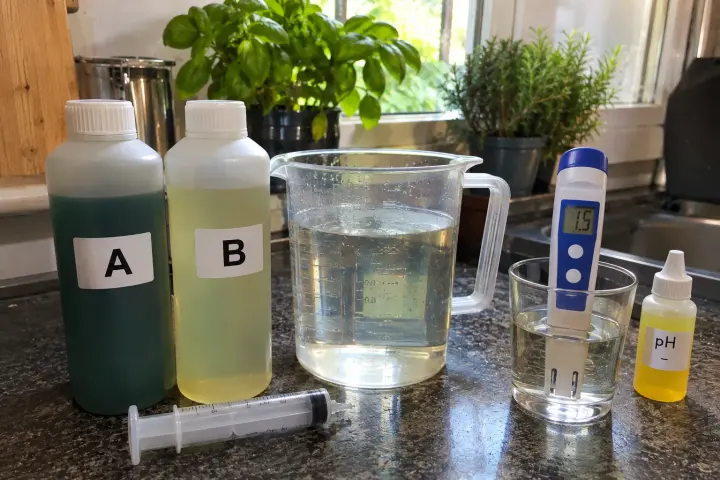
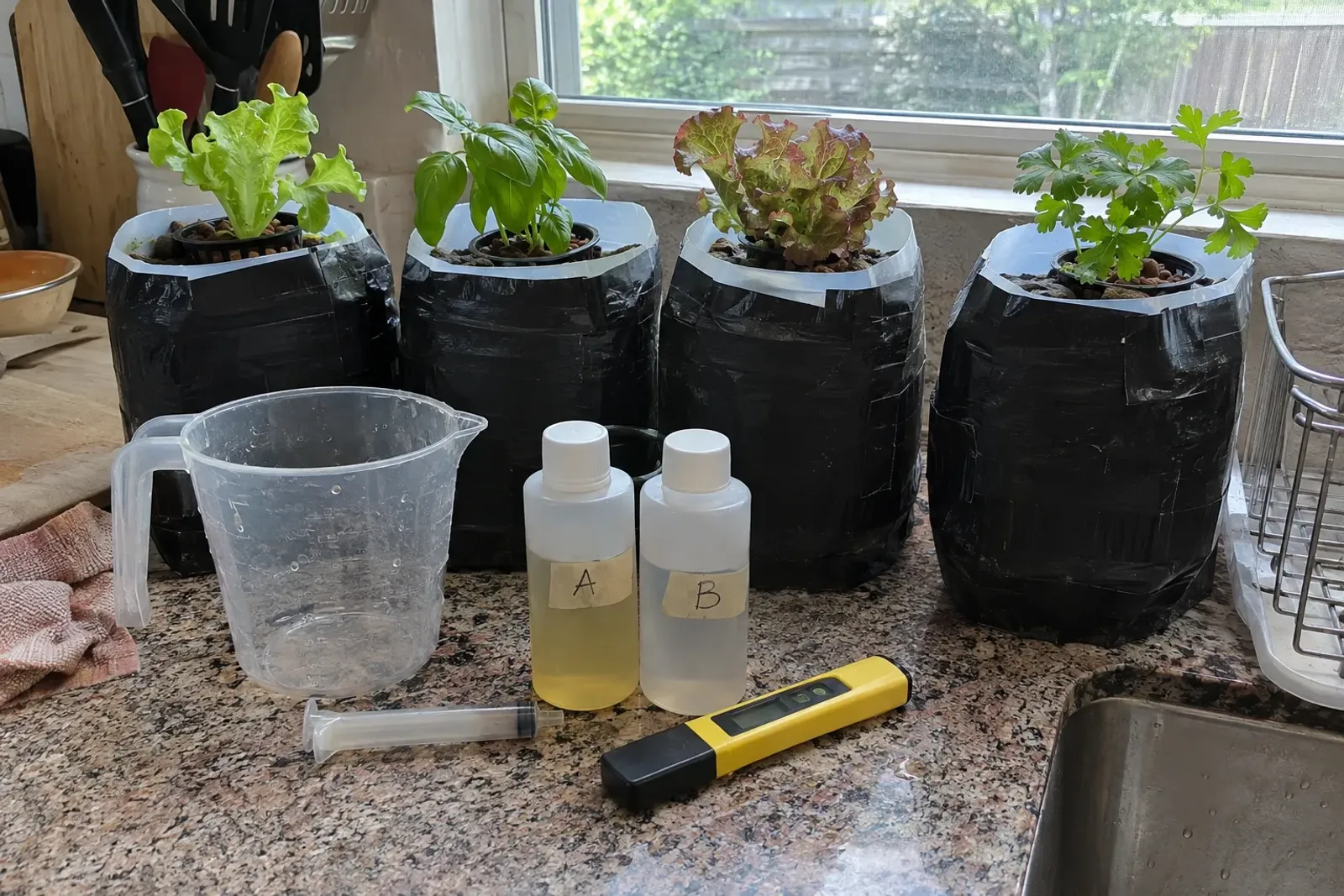
| Two-part liquid (A + B) | Complete, easy to dose | Two bottles, mix separately | Most home growers |
| Three-part powder (lettuce formula) | Cheapest per liter, precise | Must weigh powders | Many jars, regular growers |
| Organic liquids | "Natural" | Rot and smell in still water | Not recommended |
The nutrient must be labelled for hydroponics. Standard garden fertilizers lack calcium and micronutrients and often rely on urea, which plants in still water handle badly.
How much to add
Start from the label and reduce it. A Kratky jar has no circulation and no top-ups, so as water is drunk the solution slowly concentrates. Starting a little lean keeps it in the safe zone until harvest.
| Container | Water | Two-part liquid at a typical 2 ml/L label dose |
|---|---|---|
| Mason jar | 1 liter (1 quart) | 1 to 1.5 ml of each part |
| Large jar or bottle | 2 liters | 2 to 3 ml of each part |
| 1 gallon jug | 3.8 liters | 4 to 6 ml of each part |
| Storage tote | 20 liters (5 gal) | 20 to 30 ml of each part |
Measure the EC after mixing and adjust with water or a little more nutrient. Then set the pH last. Our nutrient calculator does the arithmetic for any size.
Target EC and pH by crop
| Crop | EC | pH |
|---|---|---|
| Lettuce | 0.8 to 1.2 | 5.8 to 6.2 |
| Basil | 1.0 to 1.4 | 5.8 to 6.5 |
| Spinach, kale, chard | 1.2 to 1.6 | 6.0 to 6.5 |
| Tomatoes and peppers (large Kratky) | 1.8 to 2.4 | 5.8 to 6.3 |
Topping up: the right way
Lettuce rarely needs a top-up if the container holds at least 2 liters per plant. Bigger and longer crops do. When you top up:
- Use half-strength solution, because the remaining water is already slightly concentrated.
- Add only enough to cover the bottom third of the roots. Never refill to the original level: the upper roots have adapted to air and will drown.
- Check pH after adding.
Signs your Kratky feed is off
- Pale, slow plants: too weak or pH too high.
- Brown, crispy leaf tips: too strong, or heat. Start the next jar leaner.
- Dark green, stunted leaves: often too strong.
- Slimy brown roots: usually warm water or light reaching the solution, not nutrients. See root rot.
Frequently asked questions
Can I use MasterBlend or other three-part powders for Kratky?
Yes. Three-part lettuce formulas are popular for Kratky. Dissolve each part separately in some warm water before adding it to the jar, and use roughly half the recommended rate for small jars.
Do I need to change the water in Kratky?
No. That is the point of the method. Mix once, fill once and harvest.
Can I reuse leftover Kratky solution?
It is usually unbalanced by harvest time. Pour it on garden plants and mix fresh.
Next step
- The full method: Kratky method guide
- Simple first build: mason jar Kratky
- Practice for free: Kratky Jar Challenge game