pH tells you whether roots can absorb nutrients. EC tells you how much nutrient is in the water in the first place. Together they are the two numbers every hydroponic grower checks, and EC is the one that tells you when to top up, when to dilute and when to change the reservoir.
Quick answer: EC (electrical conductivity) measures the total amount of dissolved salts, mostly fertilizer, in your solution, in mS/cm. PPM is the same reading converted to "parts per million" using a factor: 500 (US, Hanna) or 700 (EU, Truncheon). Leafy greens like an EC of 0.8 to 1.6 (400 to 800 ppm on the 500 scale); fruiting crops like tomatoes want 2.0 to 3.5. Always say which scale you use when you share a PPM number.
EC vs PPM vs TDS
EC is the real measurement: a meter passes a tiny current between two probes, and more dissolved salts carry more current. PPM (also called TDS) is not measured directly. The meter multiplies EC by a conversion factor, and different brands use different factors. That is why two growers can both say "800 ppm" and be feeding very different strengths.
| EC (mS/cm) | PPM 500 scale | PPM 700 scale |
|---|---|---|
| 0.5 | 250 | 350 |
| 1.0 | 500 | 700 |
| 1.5 | 750 | 1050 |
| 2.0 | 1000 | 1400 |
| 2.5 | 1250 | 1750 |
| 3.0 | 1500 | 2100 |
Our advice: think in EC. It is the same on every meter in the world.
EC to PPM converter
Type in any box and the others update.
Ideal EC by crop
| Crop | EC (mS/cm) | PPM (500 scale) |
|---|---|---|
| Lettuce | 0.8 to 1.2 | 400 to 600 |
| Spinach, kale, chard | 1.2 to 2.0 | 600 to 1000 |
| Basil | 1.0 to 1.6 | 500 to 800 |
| Mint, parsley | 1.2 to 1.8 | 600 to 900 |
| Strawberries | 1.0 to 1.5 | 500 to 750 |
| Peppers | 1.8 to 2.8 | 900 to 1400 |
| Tomatoes | 2.0 to 3.5 | 1000 to 1750 |
| Cucumbers | 1.7 to 2.5 | 850 to 1250 |
Seedlings and clones need far less: start at a quarter to half strength (EC 0.4 to 0.8) and raise it as true leaves appear.
Reading the trend: what EC changes tell you
The most useful thing about EC is how it moves between checks.
- EC rises while the water level drops: plants are drinking water faster than they take up nutrients. Top up with plain pH-adjusted water, not more nutrient.
- EC falls while the water level drops: plants are hungry and eating faster than they drink. Top up with a slightly stronger solution.
- EC stays stable as water drops: your strength is right. Top up with solution at the same EC.
- EC climbs steadily over weeks: unused salts are building up. Time for a full reservoir change.
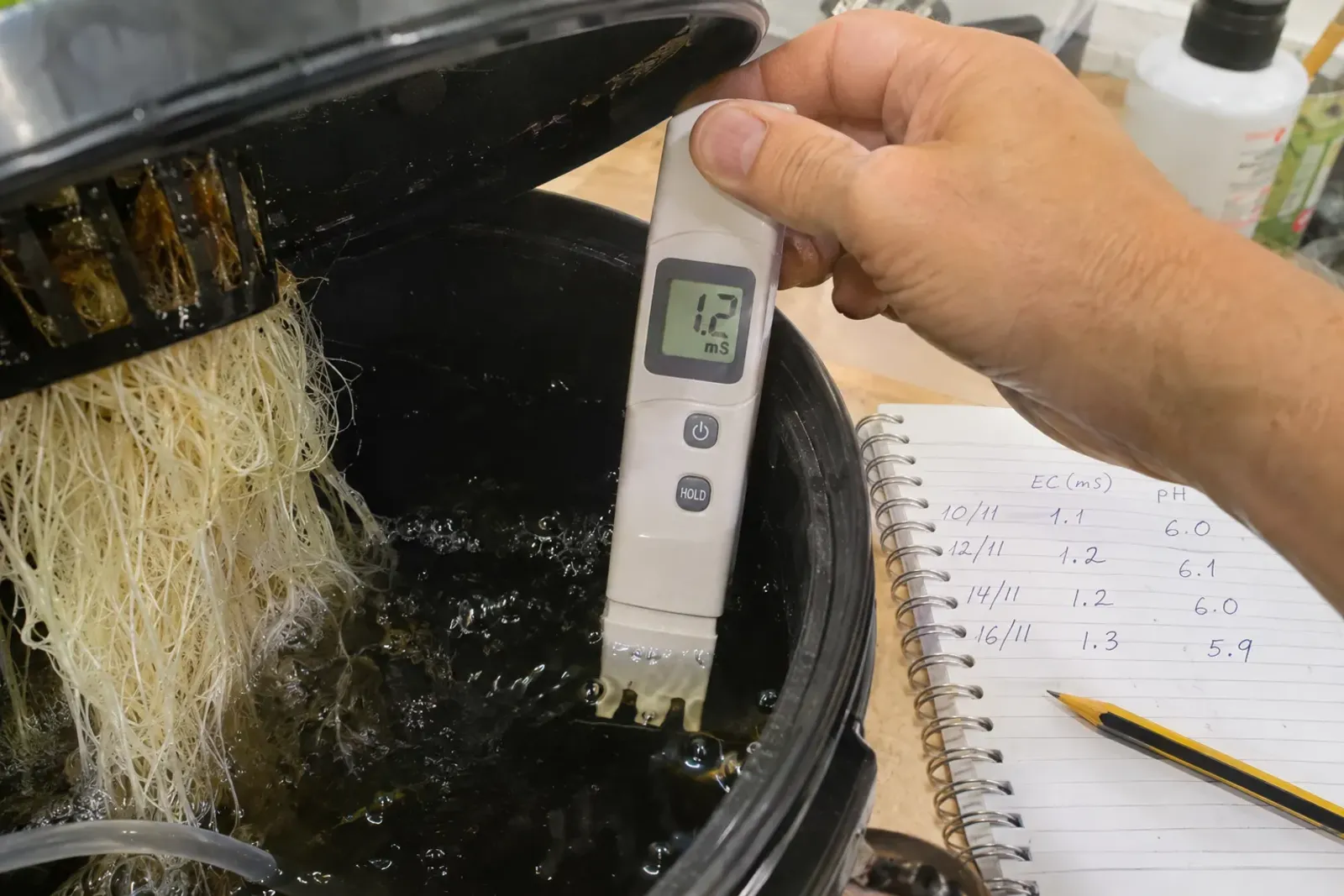
How to measure EC accurately
- Stir or circulate the solution for a few minutes first.
- Use a meter with automatic temperature compensation (ATC). EC rises about 2 percent per degree Celsius.
- Rinse the probe in clean water after each reading.
- Calibrate monthly with a 1.413 mS/cm calibration solution.
- Measure your plain tap water too. If it reads 0.3 to 0.5 already, subtract that from your target: those minerals are not all nutrients.
Frequently asked questions
What is a good EC for Kratky lettuce?
Start between 0.8 and 1.2. Because the jar is never topped up, the EC naturally rises a little as the water level drops, which suits the growing plant.
Is TDS the same as PPM?
Yes, in practice. TDS meters display PPM using one of the conversion factors. Check the manual to see whether yours uses 0.5 or 0.7.
Can EC be too low?
Yes. Below about 0.6 for most crops, growth slows and older leaves turn pale. Low EC is a common reason for slow, light-green lettuce.
Do I need both a pH meter and an EC meter?
For any recirculating system, yes. Combination meters exist and are a good choice for beginners.
Next step
- Set your pH: hydroponic pH guide
- Work out doses: nutrient calculator
- Mix a batch: how to mix hydroponic nutrients