Mixing a nutrient solution takes five minutes once you know the routine. Doing it in the wrong order, though, can lock up calcium and phosphorus before they ever reach the roots. This guide gives you the routine, the doses and the reasons behind each step.
Quick answer: Fill your container with water first and note its starting EC. Add each nutrient part separately, stirring well between parts, in the order the label gives (usually Part A or "Micro" first, then B, then "Bloom"). Never mix concentrates together undiluted. Add supplements next, check EC and adjust to your target, then adjust pH last to 5.8 to 6.2.
What you need
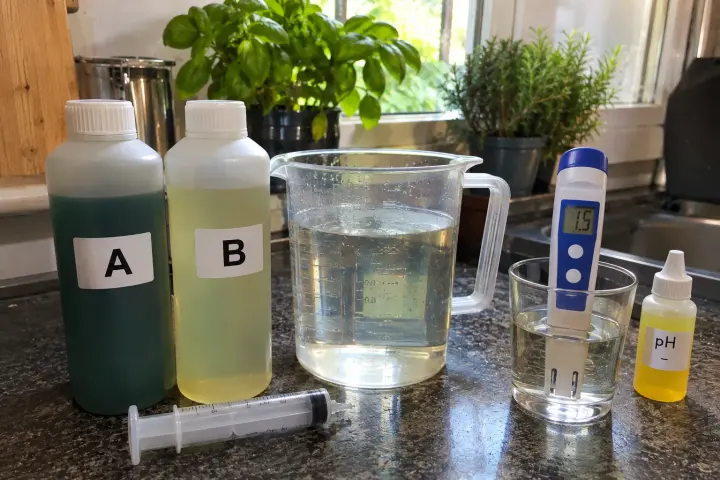
- A clean container or reservoir and a measuring jug
- Your nutrients: one-part, two-part (A and B) or three-part
- Syringes or measuring spoons, one per part to avoid contamination
- An EC or TDS meter and a pH meter or drops
- pH Down (and pH Up, just in case)
- Something to stir with
Step by step
- Start with water. Fill the container with the full volume of water. Room temperature, 18 to 22 °C (65 to 72 °F), is ideal.
- Measure the water. Note the starting EC and pH. Tap water often reads EC 0.2 to 0.5 before any nutrients go in.
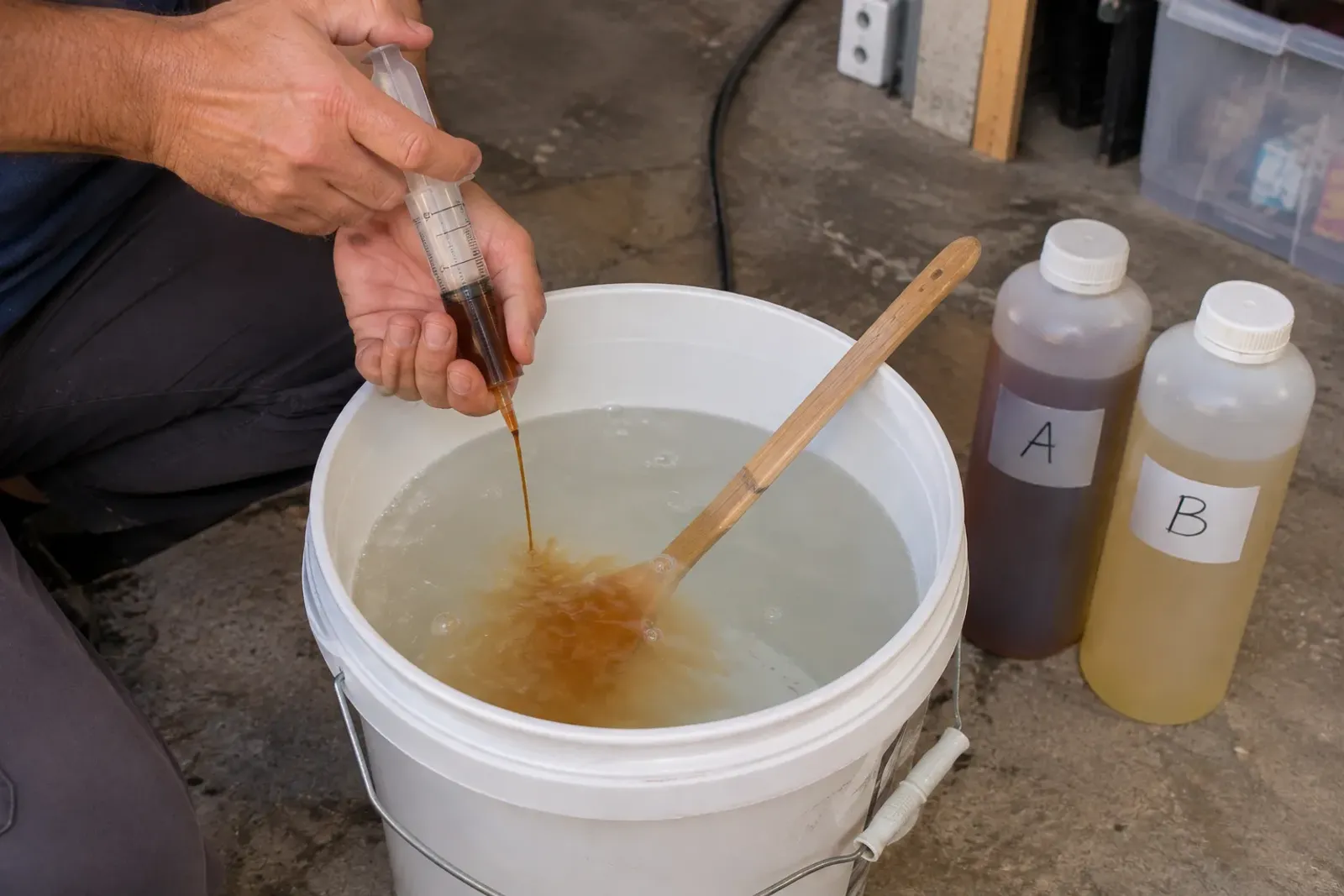
- Add the first part. Measure the dose for your volume and stir for at least 30 seconds.
- Add the next part. Again, measure, add, stir. Never pour Part A and Part B into the same cup or syringe.
- Add supplements such as Cal-Mag or silica, if you use them, following their own instructions. Silica goes in first, before any nutrients, because it raises pH sharply.
- Check EC. Compare with your target for the crop (see EC and PPM). Too high: add water. Too low: add a little more of each part in equal proportion.
- Adjust pH last. Bring it to 5.8 to 6.2 in small steps (see hydroponic pH).
- Label and use. Write the date, EC and pH on the reservoir. Mixed solution is best used within a week or two.
Why the order matters
Concentrated calcium (in Part A) and concentrated phosphates and sulfates (in Part B) react with each other and form insoluble crystals, basically chalk. Once that happens, the nutrients are gone, even though the bottle is empty. Diluting each part in plenty of water first keeps them apart until they are too dilute to react.
How much nutrient to use
Every brand is different, so start from the label. As a rough guide, most two-part liquid nutrients use 1 to 4 ml of each part per liter for leafy greens. Many growers find the label's full dose too strong for lettuce and herbs and get better results at half to three quarters strength. Let your EC meter decide, not the bottle.
| Crop | Target EC | Typical strength vs label |
|---|---|---|
| Seedlings | 0.4 to 0.8 | Quarter to half |
| Lettuce and herbs | 0.8 to 1.6 | Half to three quarters |
| Tomatoes, peppers | 2.0 to 3.0 | Full |
Use our nutrient calculator to work out exact amounts for your reservoir size.
Powder nutrients
Dry nutrients such as the popular three-part lettuce formulas are cheaper per liter. Dissolve each powder in a small amount of warm water first, then add it to the reservoir. As with liquids, add each part separately and stir in between. Store powders sealed and dry.
Common mistakes
- Mixing concentrates together. The number one cause of lockout.
- Adjusting pH first. Nutrients change pH, so the adjustment is wasted.
- Using the same syringe for every part. Small amounts of residue are enough to react.
- Topping up a tired reservoir forever. Unused salts build up. Change the solution every two to three weeks in recirculating systems.
- Very hot or cold water. Cold water dissolves powders poorly; warm water above 26 °C (79 °F) holds little oxygen.
Frequently asked questions
Can I pre-mix nutrients and store them?
Yes, at working strength in a dark, closed container for up to two weeks. Never store mixed concentrates.
Do I need Cal-Mag?
Only if you use soft, RO or rain water, or your nutrient brand recommends it. Hard tap water already contains calcium and magnesium.
What if I added too much nutrient?
Add plain water until the EC is back on target, then check the pH again.
Next step
- Choose the right feed: hydroponic nutrients guide
- Feeding lettuce: best nutrients for lettuce
- Work out doses: nutrient calculator