If your plants look hungry even though the reservoir is full of nutrients, check the pH first. In hydroponics, pH decides which nutrients the roots can actually absorb. Get it wrong and a perfectly mixed solution starves the plant. Get it right and most other problems become easier to solve.
Quick answer: Most hydroponic crops grow best at a pH between 5.5 and 6.5, with 5.8 to 6.2 a safe target for almost everything. Test with a calibrated pH pen or drops, adjust in small steps with pH Down (usually phosphoric acid) or pH Up (potassium hydroxide or carbonate), wait 15 to 30 minutes, then test again. Always add nutrients first and adjust pH last.
Why pH matters so much
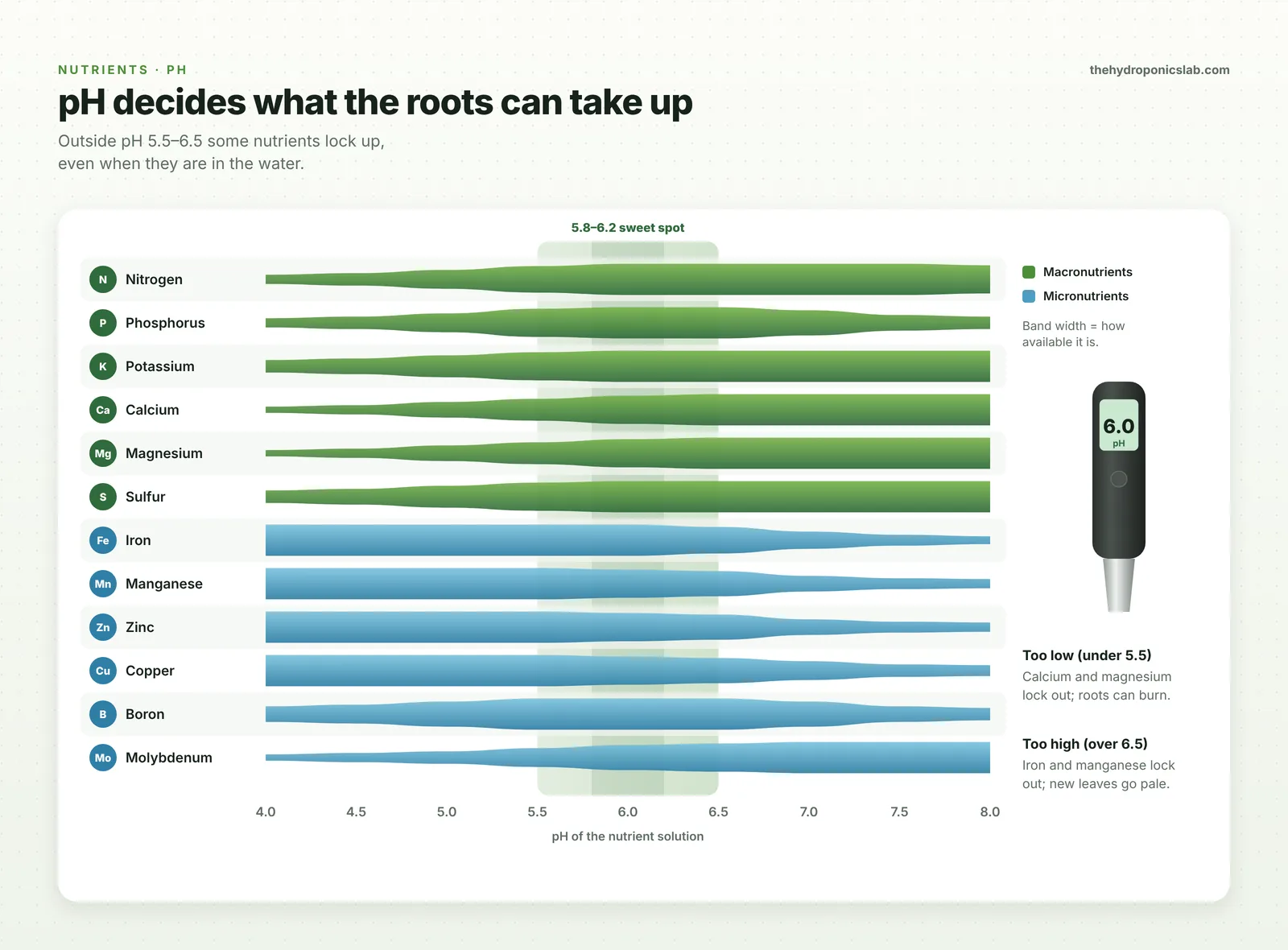
pH measures how acidic or alkaline the solution is, on a scale from 0 to 14. Plants do not "feel" pH directly, but it changes the chemistry of every nutrient in the water. Iron, manganese and phosphorus lock up when the pH climbs too high. Calcium and magnesium become harder to take up when it drops too low. Each nutrient has a window, and the 5.5 to 6.5 range is where those windows overlap best.
Ideal pH by crop
| Crop | Target pH |
|---|---|
| Lettuce and leafy greens | 5.8 to 6.2 |
| Basil | 5.8 to 6.5 |
| Mint, parsley, chives | 6.0 to 6.5 |
| Spinach and kale | 6.0 to 7.0 |
| Tomatoes and peppers | 5.8 to 6.3 |
| Cucumbers | 5.8 to 6.0 |
| Strawberries | 5.5 to 6.2 |
If you grow several crops in one reservoir, aim for 6.0. Nothing on this list minds it.
How to test pH
| Method | Accuracy | Cost | Notes |
|---|---|---|---|
| Liquid drops | About ±0.5 | Very low | Fine to start, hard to read in the 5.5 to 6.5 zone |
| Test strips | About ±0.5 | Low | Same limits as drops |
| Digital pH pen | ±0.1 | Low to medium | The best investment for any recirculating system |
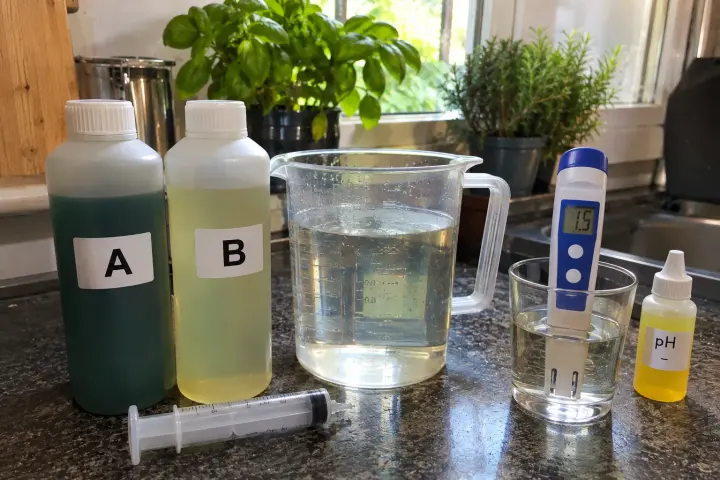
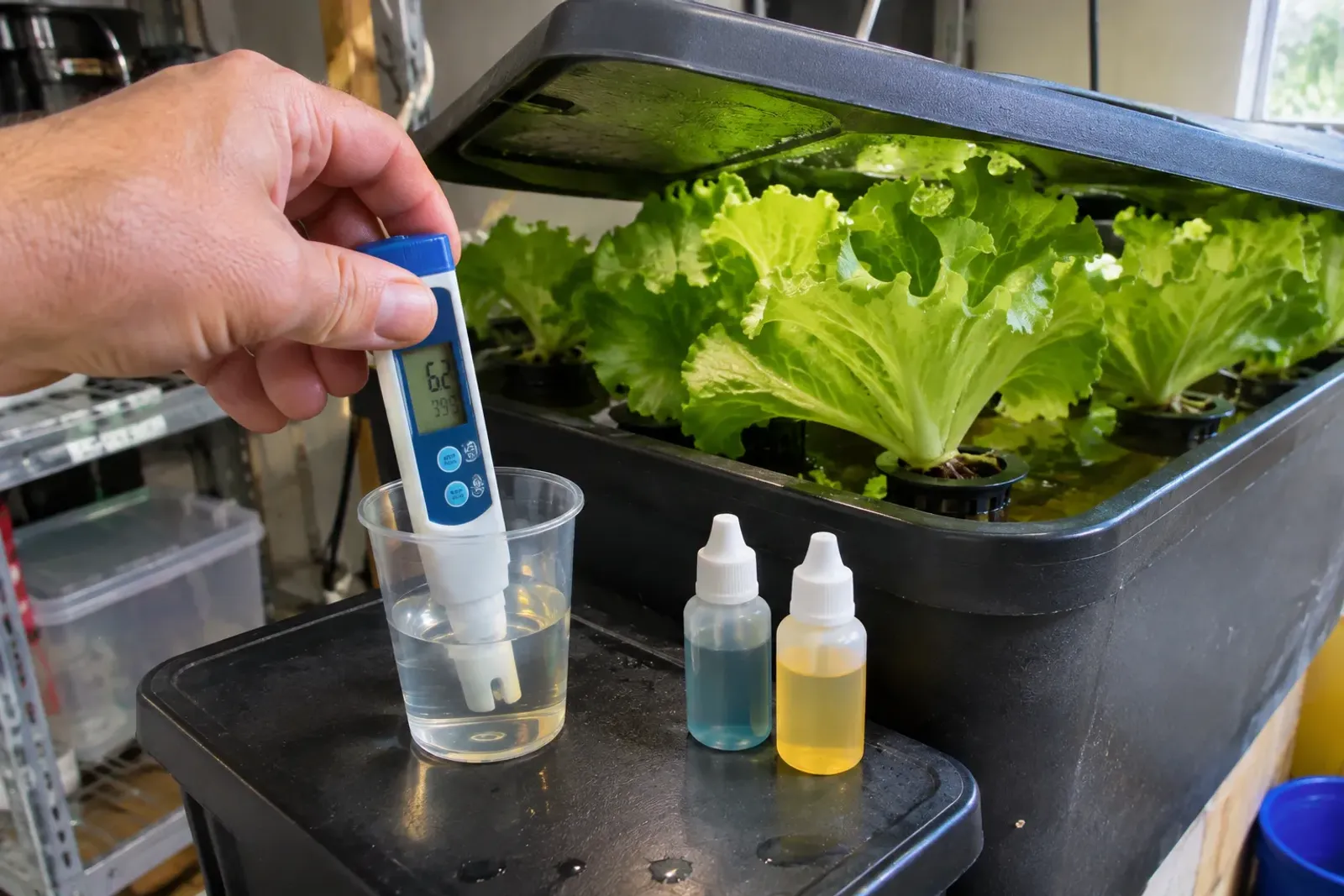
A pH pen only stays accurate if you look after it. Calibrate it every two to four weeks with pH 7.0 and 4.0 buffer solutions, store the tip moist in storage solution (never in plain water), and rinse it after every reading.
How to adjust pH, step by step
- Mix the nutrients first. Fertilizer salts shift pH, so adjusting before adding them is wasted effort.
- Measure the pH after the solution has been stirred or circulated for a few minutes.
- Add a small dose. Start with about 1 ml of pH Down or Up per 4 liters (1 gallon), less for small jars.
- Mix and wait 15 to 30 minutes, then test again.
- Repeat until you are in range. Stop at the upper end of your target: pH usually drifts up, not down.
Never pour pH Up and pH Down in together, and never mix them neat in a cup. They react strongly. Wear gloves and keep both away from children.
Why pH drifts
- Plants pull it up. As roots take in nitrate, they release compounds that raise pH. A slow rise of 0.1 to 0.3 per day is normal in a healthy system.
- Hard tap water contains carbonates that buffer against pH Down and push pH back up. If you constantly fight a rising pH, test your water's hardness or mix in some RO or rain water.
- Fast drops usually mean something is decaying: dead roots, algae or root rot. Smell the reservoir and check the roots.
- Small volumes swing faster. A 1-liter Kratky jar drifts far more than a 60-liter DWC tub.
Do you need to adjust pH in Kratky?
Less than you think. Set the pH between 5.8 and 6.2 at the start, and most Kratky jars stay in a workable range until harvest. Checking once a week is plenty. The full routine is in our Kratky method guide.
Frequently asked questions
What happens if hydroponic pH is too high?
Above about 6.5, iron and manganese become less available. New leaves turn pale yellow with green veins, the classic sign of iron deficiency, even though the iron is in the water.
What happens if pH is too low?
Below about 5.5, calcium and magnesium uptake suffers and roots can be damaged. Look for brown spots, curled new growth and weak roots.
Can I use vinegar or lemon juice to lower pH?
They work in an emergency, but the effect is short-lived and organic acids can feed bacteria. Phosphoric or nitric acid based pH Down is more stable and cheaper per dose.
How often should I check pH?
Daily for NFT and small recirculating systems, every two or three days for DWC, and weekly for Kratky.
Next step
- Measure strength too: EC and PPM explained
- Mix it right: how to mix hydroponic nutrients
- Fix the symptom: yellow leaves in hydroponics