Yellow leaves are the most common thing hydroponic growers worry about, and the good news is that they are usually easy to fix. The key is to read the pattern: which leaves turn yellow, and how, points straight to the cause. Then check two numbers before adding anything to the water.
Quick answer: First check pH and EC. Most yellowing in hydroponics comes from pH outside 5.5 to 6.5, which locks out nutrients, or an EC that is too low. Then look at where it starts. Yellowing of old, lower leaves usually means nitrogen or magnesium shortage. Yellowing of new, top leaves usually means iron, often caused by high pH. Yellowing with wilting and brown roots means a root problem, not a nutrient one.
Step 1: check pH, EC and roots
| Check | Healthy range | If not |
|---|---|---|
| pH | 5.5 to 6.5 (5.8 to 6.2 ideal) | Adjust; see hydroponic pH |
| EC | Crop target, e.g. 0.8 to 1.2 for lettuce | Raise or dilute; see EC and PPM |
| Roots | White or cream, firm, fresh smell | Brown and slimy: see root rot |
| Water temperature | 18 to 22 °C (65 to 72 °F) | Cool the reservoir |
| Solution age | Under 2 to 3 weeks | Change the reservoir |
In practice, one of these five fixes most yellow leaves.
Step 2: read the pattern
| Where and how | Most likely cause |
|---|---|
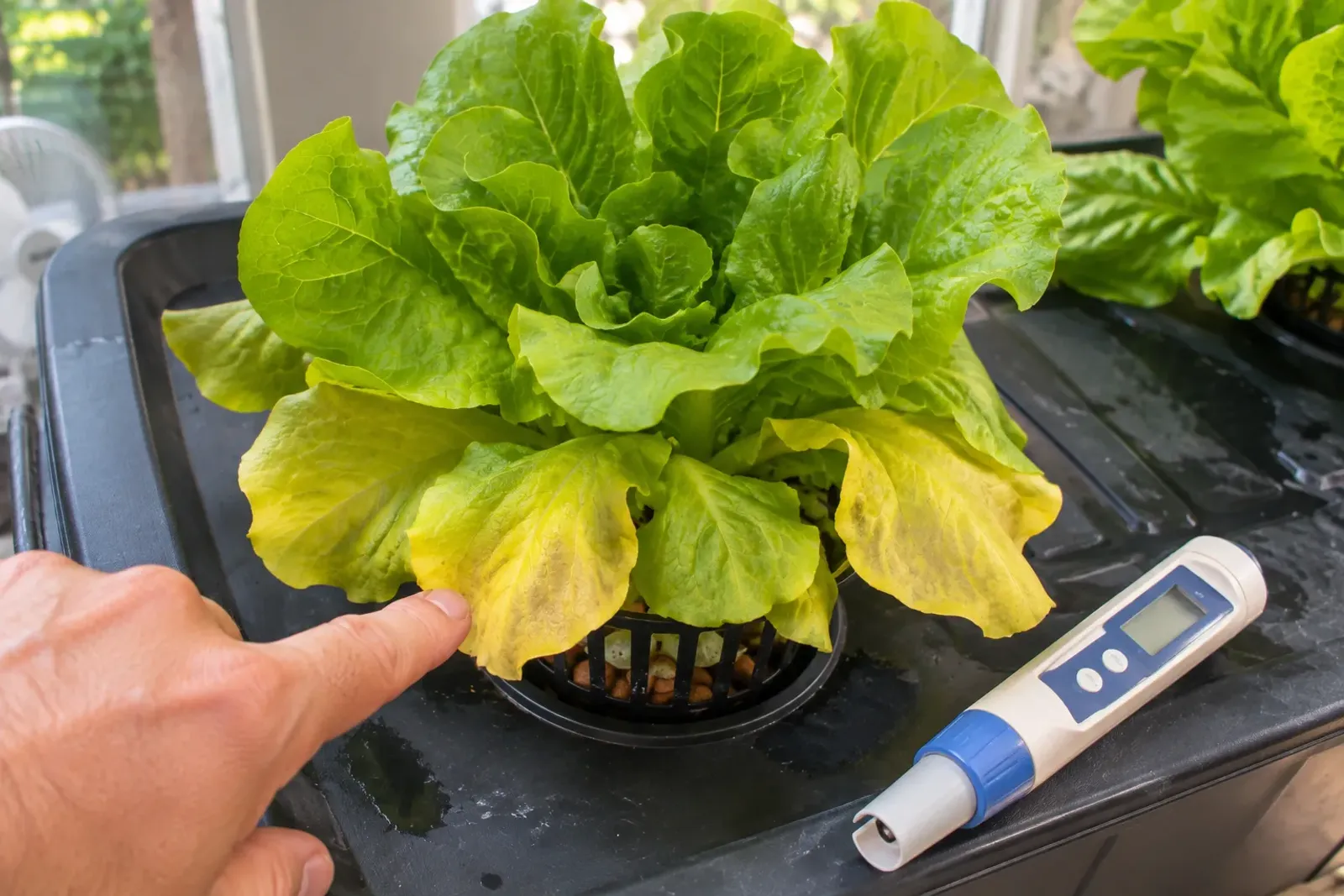
| Oldest leaves turn evenly pale yellow, then the yellowing moves up | Nitrogen deficiency |
| Old leaves yellow between the veins, veins stay green | Magnesium deficiency |
| New leaves pale yellow with green veins | Iron deficiency (often pH too high) |
| New leaves pale or white, growing tips distorted | Calcium or boron, usually heat or humidity |
| Old leaves yellow with brown, scorched edges | Potassium deficiency |
| Whole plant pale, slow, all leaves | EC too low, or not enough light |
| Yellow with wilting, even though the water is full | Root damage, low oxygen, warm water |
| One or two bottom leaves yellow on a big healthy plant | Normal aging. Remove them |
The common causes in detail
Nitrogen
The most common deficiency, especially late in a Kratky crop when the solution is getting tired. Plants move nitrogen from old leaves to new growth, so the bottom of the plant fades first. Fix: refresh the solution or top up at the correct EC.
Magnesium
Shows as yellowing between the veins on older leaves, sometimes with a marbled look. Common with RO or soft water. Fix: add Cal-Mag, or Epsom salt at about 0.25 to 0.5 g per liter.
Iron
New leaves turn pale yellow while the veins stay green. In hydroponics, iron is rarely missing from the bottle; it becomes unavailable when pH rises above about 6.5. Fix: lower the pH first. If it continues, use a nutrient with chelated iron (DTPA or EDDHA).
Light and temperature
Too little light makes plants pale and stretched. Cold roots, below 15 °C (60 °F), slow nutrient uptake and can turn leaves yellow-purple. Hot water above 24 °C (75 °F) holds little oxygen and stresses roots.
Can yellow leaves turn green again?
Leaves with mild, recent yellowing often recover once the cause is fixed. Leaves that are fully yellow or brown will not. Remove them, and judge your fix by the new growth over the next week.
Frequently asked questions
Why are my Kratky lettuce leaves turning yellow at the bottom?
Usually the solution is running low on nitrogen near the end of the crop, or the pH has drifted up. Harvest soon, or top up a little with half-strength solution.
Should I add more nutrients when leaves turn yellow?
Not before checking pH. Adding nutrients to a solution with the wrong pH just adds more locked-out salts.
Can too much nutrient cause yellow leaves?
Yes. Very high EC causes nutrient burn: yellow-brown, crispy tips and edges. Dilute with water.
Next step
- Get the basics right: hydroponic pH and EC and PPM
- Root trouble: hydroponic root rot
- More fixes: problems and fixes