Many growers come to hydroponics wanting food that feels natural, and the idea of feeding plants with "chemical salts" puts some people off. Organic hydroponics is possible, but it behaves very differently from a mineral system. Before you pour fish emulsion into a reservoir, it helps to understand why.
Quick answer: Yes, you can grow hydroponically with organic nutrients, but it is harder. Organic fertilizers must be broken down by microbes before plants can use them, and in a reservoir that process can cause cloudy water, smells, biofilm, clogged pumps and root rot. Liquid organics made for hydroponics, a healthy microbial population, strong aeration and frequent water changes make it work. For beginners, mineral nutrients are far more reliable.
Why organics are tricky in water
Plants do not absorb "organic" or "mineral" nutrients. They absorb ions: nitrate, potassium, calcium and so on. Mineral salts dissolve straight into those ions. Organic materials like fish, seaweed or compost tea contain nutrients locked inside larger molecules, which bacteria must first break down. In soil, billions of microbes do that job quietly. In a bucket of water, the same process consumes oxygen and can feed the wrong bacteria.
Mineral vs organic: an honest comparison
| Mineral salts | Organic liquids | |
|---|---|---|
| Availability to plants | Immediate | Depends on microbes |
| Precision (EC, ratios) | High | Low, EC readings less meaningful |
| Water clarity | Stays clear | Often cloudy, can smell |
| Clogging pumps and emitters | Rare | Common |
| Root rot risk | Low if aerated | Higher |
| Flavor | Excellent when fed correctly | Some growers prefer it |
| Best systems | Any | DWC with strong aeration, ebb and flow, media beds |
Organic options that work best
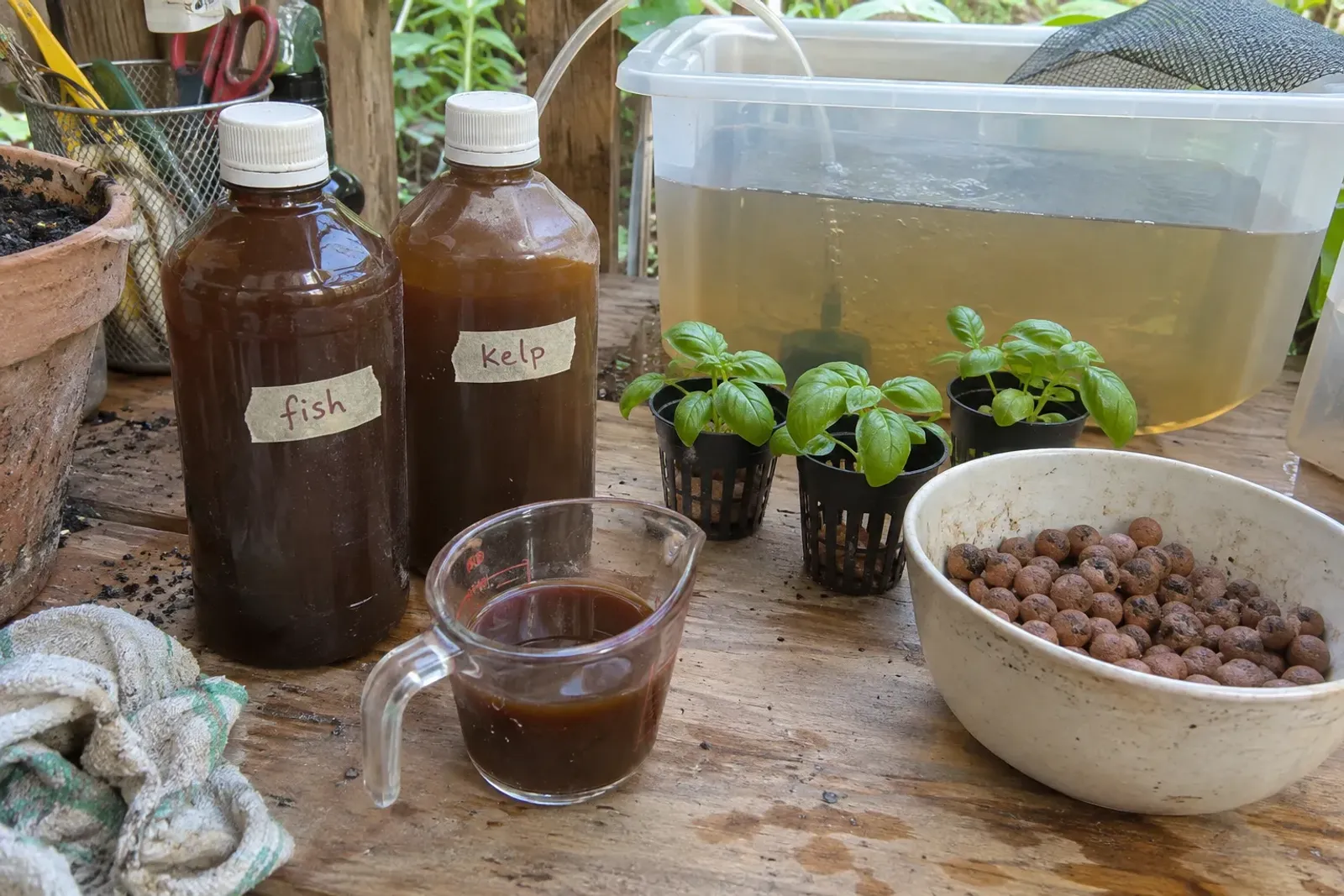
- Hydroponic-specific organic liquids. Pre-digested, filtered and designed not to clog. The easiest starting point.
- Fish hydrolysate (not fish emulsion). Enzymatically digested, with less sludge. Use at low doses.
- Liquid seaweed or kelp. A good source of potassium and trace elements, best used as a supplement.
- Aquaponics. Fish waste converted by a biofilter into nitrate. It is the most successful form of organic soilless growing, because the whole system is designed around the microbes.
Avoid raw manures, compost and granular organic fertilizers in water. They rot.
How to make organic hydroponics work
- Use a medium with surface area for microbes: clay pebbles, coco or a biofilter.
- Aerate hard. Twice the air you would use with mineral nutrients.
- Add beneficial microbes so the right bacteria colonize first.
- Feed little and often. Half doses twice as often beat one heavy dose.
- Keep the water cool, below 22 °C (72 °F).
- Change the solution weekly and clean filters and pumps.
- Watch the roots, not the meter. EC does not tell you much about organic feeds, so healthy white roots and steady growth are your guide.
A middle path
Many home growers use mineral nutrients for the base feed and add a small amount of seaweed extract or beneficial microbes. You get the reliability of salts with some of the biological benefits, and the water stays clean.
Frequently asked questions
Is hydroponic food organic?
In the US, hydroponic produce can be certified organic if it uses approved inputs. In the UK and EU, organic rules require soil, so hydroponic crops cannot be labelled organic.
Can I use compost tea in hydroponics?
Not as the main feed. It is too variable and can introduce pathogens. Small doses as a microbial inoculant are sometimes used in media-based systems.
Are mineral nutrients bad for you?
No. Plants take up the same ions from mineral salts as they do from broken-down organic matter. What matters for health is clean water, correct feeding and a good harvest.
Next step
- The basics of feeding: hydroponic nutrients guide
- Mix it right: how to mix hydroponic nutrients
- When the water goes bad: hydroponic root rot