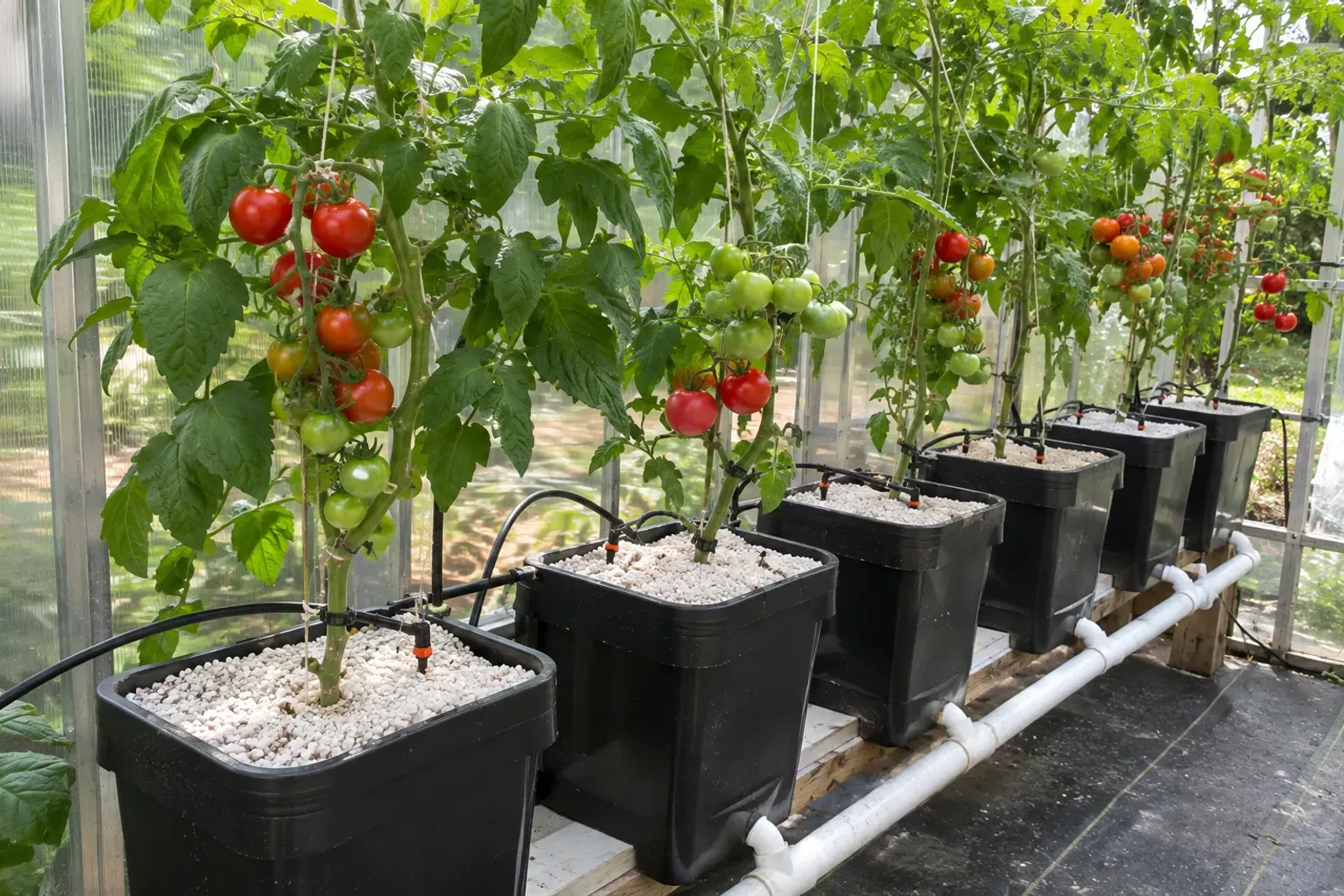
If you have ever wondered how greenhouses grow tomato vines taller than a person without a speck of soil, the answer is usually a drip system. Each plant gets its own small emitter that delivers nutrient solution right at the base, several times a day. It is precise, scalable and the go-to system for large fruiting crops.
Quick answer: A hydroponic drip system pumps nutrient solution from a reservoir through tubing to an emitter at the base of each plant, on a timer. The solution soaks through a growing medium such as coco coir, rockwool or perlite. In a recovery system the runoff returns to the reservoir; in a non-recovery system it drains to waste. Drip is the best home system for tomatoes, peppers, cucumbers and other big plants.
How a drip system works
- Reservoir with nutrient solution.
- Pump that feeds a main line on a timer.
- Main line and drip lines: thin tubes running to each plant.
- Emitters or drip stakes that release a measured flow at the base of each plant.
- Containers with medium, such as Dutch (Bato) buckets or slabs.
- Return line (recovery systems only) collecting runoff back to the reservoir.
Recovery vs non-recovery
| Recovery (recirculating) | Non-recovery (run to waste) | |
|---|---|---|
| Runoff | Returns to reservoir | Drains away |
| Water and nutrient use | Low | Higher |
| pH and EC | Drift, check daily | Stable, always fresh feed |
| Best for | Home growers, small setups | Commercial growers with precise dosing |
At home, recovery systems are the usual choice. Commercial growers often run to waste, aiming for 10 to 30 percent runoff so salts never build up in the medium.
Timer settings
| Medium | Starting schedule (lights on) |
|---|---|
| Coco coir | 3 to 6 short feeds per day, 1 to 3 minutes each |
| Rockwool slabs | 2 to 5 feeds, aim for 10 to 20 percent runoff |
| Perlite or clay pebbles in Dutch buckets | Every 1 to 2 hours, 2 to 5 minutes |
The goal is a medium that never dries out completely and never stays soaked. Bigger plants in hot weather drink far more, so increase the number of feeds as they grow.
Dutch buckets
A Dutch bucket is a rectangular container filled with perlite or clay pebbles, with a siphon elbow that keeps a small amount of solution at the bottom and drains the rest into a shared return pipe. A line of Dutch buckets on one pump is the classic home setup for tomatoes, cucumbers and peppers: one plant per bucket, one emitter per plant.
Pros and cons
| Pros | Cons |
|---|---|
| Precise feeding for each plant | Emitters can clog with salts or roots |
| Ideal for large, long-season crops | More parts and fittings than DWC |
| Easy to scale along a line | Recovery systems need frequent pH and EC checks |
| Medium buffers short pump failures | Medium must be bought and flushed |
Best crops
Tomatoes, peppers, cucumbers, eggplants, melons and strawberries do very well. Lettuce and herbs can be grown on drip, but Kratky, DWC or NFT are simpler and cheaper for them.
Common mistakes
- Clogged emitters: use a filter on the pump intake and flush lines between crops.
- Uneven flow: emitters at the end of a long line get less. Use pressure-compensating emitters.
- Never checking runoff: measure the EC of the runoff. If it climbs well above the feed EC, salts are building up; flush with plain water.
- One feed size for all ages: seedlings need far less than mature vines.
Frequently asked questions
How long should a hydroponic drip system run?
Short and frequent beats long and rare. In coco, start with 1 to 3 minute feeds three to six times while the lights are on, then adjust based on how wet the medium is and how much runs off.
What is the best medium for a drip system?
Coco coir and rockwool are the most common. Perlite and clay pebbles are popular in Dutch buckets because they drain freely.
Do I need to run a drip system at night?
Usually not, because plants drink much less without light. In very hot climates, one feed during the night can help.
Can I grow tomatoes hydroponically at home with drip?
Yes. A row of Dutch buckets with one tomato each is one of the most productive home hydroponic setups. See hydroponic tomatoes.
Next step
- Grow the right crop: hydroponic tomatoes and hydroponic strawberries
- Get the feed right: how to mix hydroponic nutrients
- Compare all systems: types of hydroponic systems