Hydroponic tomatoes are how most of the world's greenhouse tomatoes are grown. At home, they are the step up from lettuce and herbs: a bigger project, a longer season, and a much bigger reward when the first truss ripens on the vine.
Quick answer: Grow tomatoes in a drip system with Dutch buckets, a large DWC bucket, or a large Kratky tote for dwarf varieties. Feed at EC 1.2 to 1.6 while the plant grows and 2.0 to 3.5 once it fruits, with pH 5.8 to 6.3. Give at least 14 hours of strong light, keep temperatures between 18 and 27 °C (65 and 80 °F), prune indeterminate vines to one or two stems, and hand-pollinate flowers indoors.
Best system for tomatoes
| System | Fit | Notes |
|---|---|---|
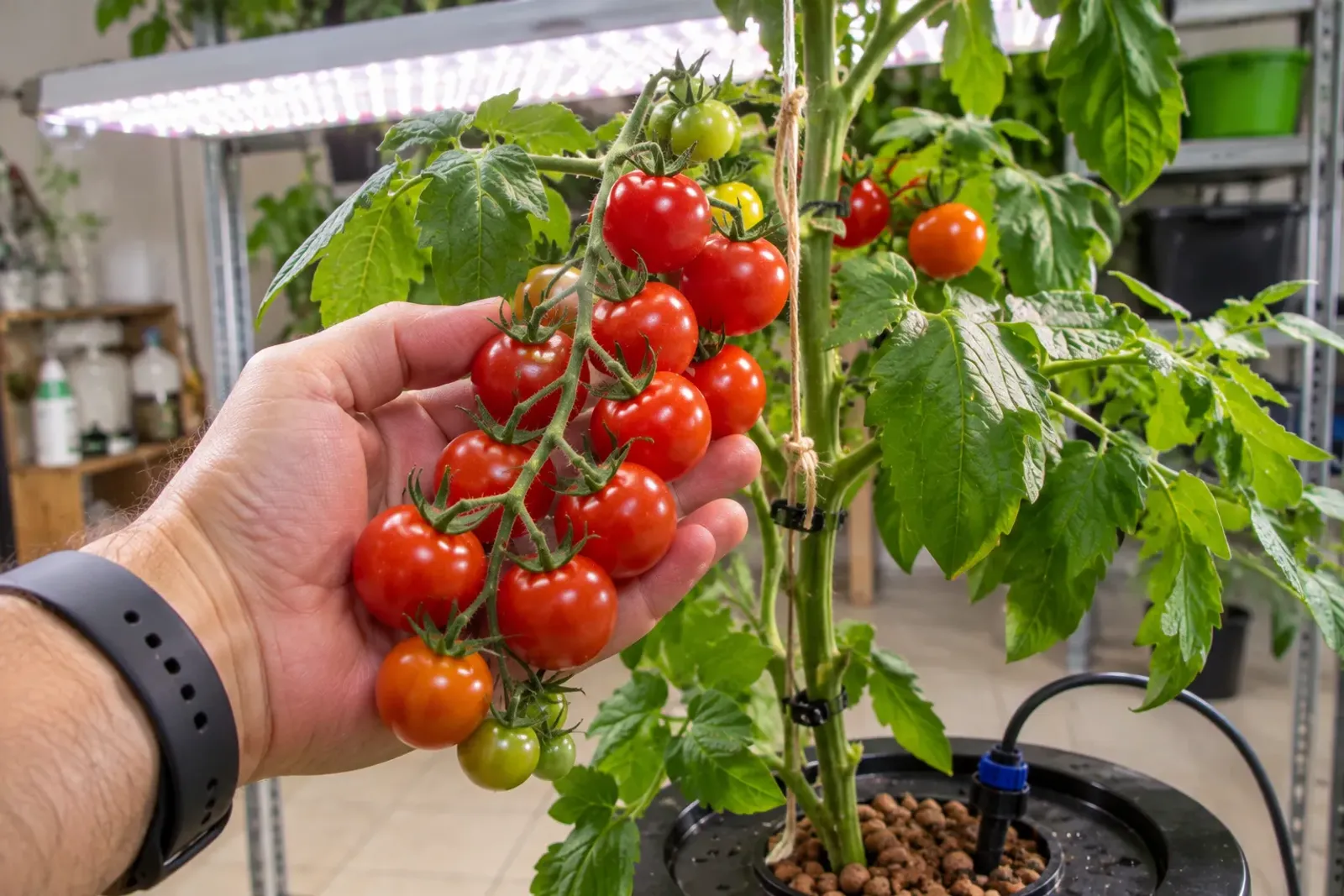
| Drip with Dutch buckets | Excellent | The standard for full-size vines. See drip systems |
| DWC (5 gallon or larger) | Very good | Fast, simple, needs strong aeration and cool water |
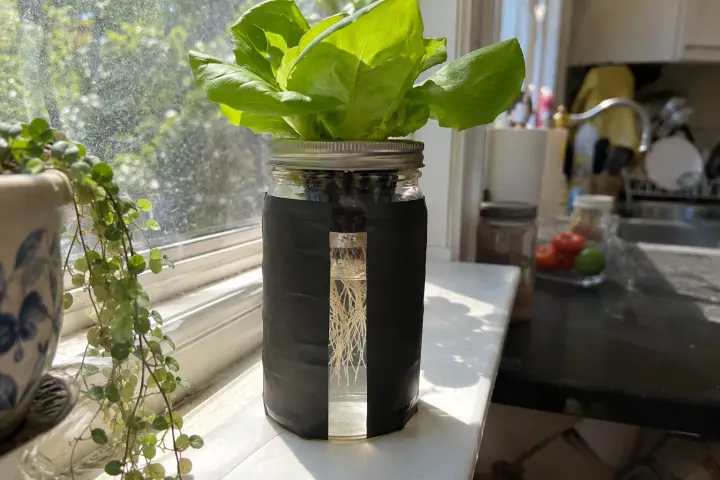
| Kratky (large tote) | Good for dwarfs | Low effort; see Kratky tomatoes |
| Ebb and flow | Good | For compact varieties in pots |
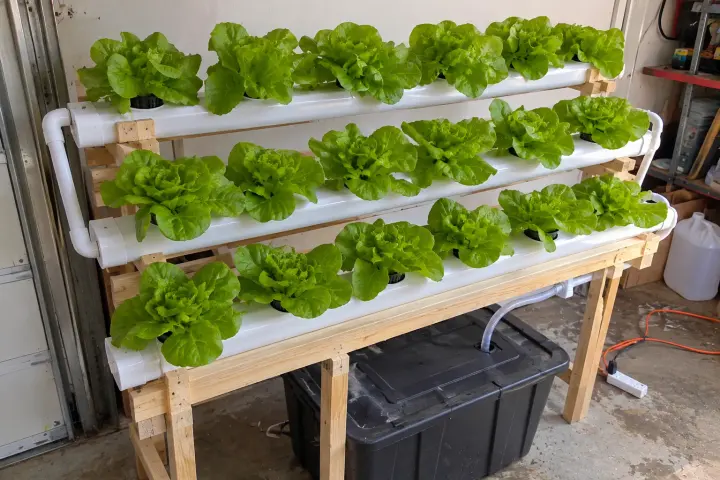
| NFT | Poor | Root mass clogs channels |
Choosing a variety
- Cherry tomatoes (Sungold, Sweet Million) are the most productive and forgiving.
- Determinate bush types (Patio, Celebrity) stay compact and ripen in a burst. Great for small spaces.
- Indeterminate slicers (Big Beef, Beefsteak types) need tall supports and pruning but crop for months.
- Greenhouse varieties bred for hydroponics resist disease and set fruit reliably.
Feeding by stage
| Stage | EC | pH |
|---|---|---|
| Seedling | 0.8 to 1.2 | 5.8 to 6.2 |
| Vegetative | 1.2 to 1.6 | 5.8 to 6.2 |
| Flowering | 1.8 to 2.4 | 5.8 to 6.3 |
| Fruiting | 2.0 to 3.5 | 5.8 to 6.3 |
Higher EC in fruiting improves flavor and sugar, at the cost of slightly smaller fruit. Tomatoes use a lot of potassium and calcium once fruit sets, so switch to a bloom-ratio nutrient or a tomato-specific formula.
Light and temperature
- Light: 14 to 18 hours. Indoors that means a strong LED, at least 200 to 300 W of real draw for a mature plant.
- Day temperature: 21 to 27 °C (70 to 80 °F).
- Night temperature: 16 to 18 °C (60 to 65 °F).
- Above 32 °C (90 °F) flowers drop without setting fruit.
Pruning and support
- Remove suckers, the shoots that grow in the angle between the main stem and a leaf, on indeterminate types. Keep one or two main stems.
- Support early. Use strings from the ceiling, stakes or cages. Lower and lean the vine when it reaches the top.
- Remove lower leaves below the first ripening truss for airflow.
- Do not prune determinate types heavily; they set a fixed number of trusses.
Pollination
Outdoors, wind and insects shake pollen loose. Indoors, you have to do it. Every day or two while flowers are open, tap the flower trusses, shake the support string or hold an electric toothbrush against the stem behind the flowers for a couple of seconds. Midday, when humidity is moderate, works best.
Common problems
| Problem | Cause | Fix |
|---|---|---|
| Blossom end rot (black base on fruit) | Calcium not reaching fruit: uneven watering, heat, high EC | Steady feeding, keep EC in range, add Cal-Mag with soft water |
| Yellow lower leaves | Nitrogen or magnesium shortage | Refresh nutrient, check pH. See yellow leaves |
| Flowers drop | Heat, low humidity, poor pollination | Cool the space, vibrate flowers |
| Split fruit | Sudden changes in water or EC | Keep conditions stable |
| Brown slimy roots | Root rot | Cooler water, more oxygen |
Frequently asked questions
How long do hydroponic tomatoes take?
Cherry tomatoes start ripening 55 to 70 days after transplanting; larger varieties 70 to 90 days.
How much does one plant yield?
A well-run indeterminate cherry plant can produce 5 to 10 kg (10 to 20 lb) over a long season.
Can I grow tomatoes hydroponically on a balcony?
Yes. A sunny balcony is often better than indoors, because sunlight is free and strong. Use a light-proof reservoir and shade it in summer.
Next step
- Build the system: hydroponic drip systems
- Passive option: Kratky tomatoes
- Work out doses: nutrient calculator